Evolve Psychiatry · BrainsWay Deep TMS
Deep TMS Therapy for Depression
A noninvasive, in-office treatment for patients with major depressive disorder who have not achieved satisfactory improvement from antidepressant medication. No anesthesia required.
- New Patients: Consultation is required. Please schedule an appointment above.
- Existing Patients: Bring up TMS with your provider at your next psychiatric appointment.
About 20 minutes
for a typical session
In-office care
at an Evolve location
No anesthesia
awake and alert throughout
Personalized plan
set through clinical evaluation
What Is Deep TMS?
A noninvasive option when medication has not provided enough relief.
Deep transcranial magnetic stimulation, or Deep TMS, uses magnetic pulses produced by a treatment coil to stimulate targeted nerve cells. Evolve uses the BrainsWay Deep TMS system, which is FDA-cleared for major depressive disorder, for eligible patients who have not achieved satisfactory improvement from antidepressant medication.
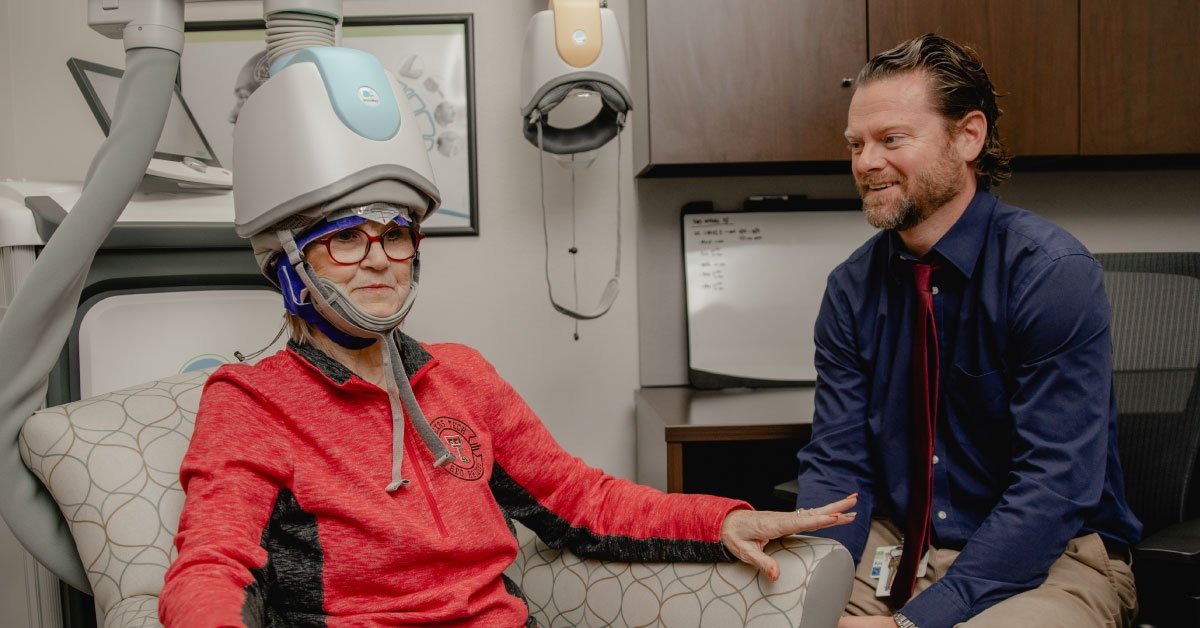
The BrainsWay system uses an electromagnetic coil contained in a treatment helmet worn during each visit. During treatment, the helmet is positioned on the patient's head and delivers brief magnetic pulses that stimulate targeted nerve cells. No anesthesia or hospitalization is required, and your schedule and protocol are set through your provider's clinical evaluation.
A psychiatric provider will review your history, previous treatment, current symptoms, and relevant safety considerations to determine whether Deep TMS may be appropriate for you. The appropriate protocol depends on the condition being treated, the device configuration, and the provider's clinical assessment.
An in-depth look at the BrainsWay technology behind Deep TMS.
Your Treatment Journey
Before treatment, a psychiatric provider reviews your history, prior treatment, current symptoms, and relevant safety considerations to determine whether Deep TMS may be appropriate.
Clinical evaluation
A psychiatric provider determines whether Deep TMS is appropriate based on your diagnosis, treatment history, and individual needs.
Treatment planning
If you are a candidate, the recommended schedule, treatment location, and what to expect during visits are reviewed with you.
Sessions and follow-up
You remain awake during treatment while the team checks how you are tolerating sessions and follows your progress.
Where Is TMS Therapy Available?
Contact Evolve to confirm current TMS availability and scheduling at the location most convenient for you.

Questions Patients Often Ask
What are the possible side effects of TMS?
Side effects and risks are possible. Evolve's current patient information identifies the following:
- Temporary scalp tenderness
- Temporary headache
- Temporary jaw pain
- Temporary tooth pain
- Rare incidence of seizure
Side effects are often temporary and may occur during or shortly after a treatment session. Your provider will review your medical history, medications, and other safety considerations before treatment and monitor how you tolerate the course.
Is Deep TMS the same as anesthesia-based treatment?
No. TMS does not require anesthesia or hospitalization. You remain awake and alert throughout the session, and you can typically resume normal activities afterward. Ask the Evolve team what activities are appropriate for you immediately after treatment.
Who determines if I am a candidate for Deep TMS?
A psychiatric provider reviews your diagnosis, treatment history, current symptoms, and relevant safety considerations before recommending Deep TMS. The appropriate treatment protocol depends on the condition being treated, the device configuration, and the provider's clinical assessment.
Could Deep TMS be an option for you?
Contact Evolve to ask questions about Deep TMS and learn whether scheduling a clinical evaluation may be appropriate.
Register as a New PatientRecent posts

Borderline personality disorder affects how a person experiences emotions, relationships, and their own identity. It can make ordinary moments, a delayed text reply, a canceled plan, feel like proof that you are about to be left.
Maybe it started as wanting to feel more in control. Maybe it crept in quietly, disguised as discipline that never seemed to end. However it began, if food, weight, or your body have taken over your thoughts in a way that feels impossible to switch off, you may be living with one of the many eating disorders that affect people every day, in every age group, and in every kind of body.
Schizophrenia is a chronic brain condition that affects how a person thinks, perceives reality, processes emotion, and relates to others. It is not a personality flaw, a moral failing, or something a person brought on themselves. It is a medical condition, similar in structure to other chronic illnesses that affect the brain, and like many of those conditions, it responds to treatment.
Understanding icd postpartum depression classification is not just paperwork. It is the difference between your insurance approving treatment and denying it, between a provider recognizing your symptoms quickly and missing them, and between you feeling dismissed or finally understood. This guide walks through what the code means, how doctors use it, and what comes next.
Postpartum depression affects new mothers and fathers alike. Learn the real signs, causes, genetic risk factors, and treatment options that bring relief.
You check your email one more time before bed, even though you told yourself you wouldn't. Your stomach tightens on Sunday night before you've even opened your laptop. You used to enjoy your job, and now you can't remember the last time you walked in without a knot in your chest.
You're not imagining it, and you're not alone.
Something as simple as a bad night's sleep can leave your thoughts foggy, your patience thin, and your mood harder to steady than usual. Multiply that feeling by weeks or months, and you start to understand why so many people quietly wonder if something deeper is going on. So what is mental health, exactly? At its core, mental health is your overall emotional, psychological, and social wellbeing.
What is fear of public speaking? Discover the signs of Glossophobia, why it happens, and compassionate, proven ways to overcome it for good, starting today.
In this guide, we will walk through what fear of public speaking really is, why it happens, and what you can do about it, including when it may be time to seek professional support.
Wondering what is fear of dogs and why it happens? Learn the real signs of cynophobia, its causes, and proven ways to overcome it for good with expert care.
This guide walks through what fear of dogs actually is, why it develops, how it shows up day to day, and what genuinely helps you move forward.
Fear of death is more common than you think. Learn what thanatophobia is, why it happens, and how evidence-based treatment can help.
You wash your hands until they feel raw. You hesitate before touching a door handle. You replay a handshake in your mind for hours afterward, wondering what you might have picked up.
This article will walk you through what fear of germs actually is, how it shows up, why it develops, and what steps can help you feel like yourself again.
Fear of needles affects people of all ages and often leads to avoided medical care. Learn the causes, symptoms, and treatment options for trypanophobia.
Understanding why this fear develops, and what actually helps, is the first step toward feeling steady again.
What is fear of failure, exactly? It is more than just pre-game nerves or wanting to do well. For many people, it is a deep, persistent dread that quietly takes over decision-making, dims ambition, and chips away at self-worth.
Let’s understand what fear of failure is, whether it can become a clinical condition known as atychiphobia, what causes it, and most importantly, what you can do about it.
What is acrophobia, exactly? Why does a simple view from above trigger such an intense, full-body response? And perhaps most importantly: is there anything you can do about it?
Acrophobia is real, it is recognized, and it is treatable. This article will walk you through the psychology behind it, what it feels like, why it develops, and what evidence-based treatment looks like today.
What is aviophobia? It is the clinical term for an intense, persistent fear of flying or being on an aircraft. It is more than the ordinary flutter of pre-travel anxiety most people feel. For many people, aviophobia is a full-blown specific phobia that shapes decisions, limits opportunities, and quietly shrinks the world around them.
Claustrophobia is an intense, persistent fear of enclosed or confined spaces. It belongs to a group of mental health conditions known as specific phobias, which are anxiety disorders characterized by an excessive or irrational fear of a particular situation or object.
Arachnophobia is one of the most common phobias in the world, yet it is widely misunderstood. People are often told to simply get over it, as if logic alone could switch off a deeply wired response. The truth is far more interesting and more compassionate than that. Understanding what arachnophobia is, why it develops, and what can actually be done about it is the first step toward real relief.
This article walks you through exactly what phobia treatment with CBT looks like, from the very first appointment all the way through to recovery. By the end, you will have a clear picture of what to expect, why it works, and why taking that first step is far less daunting than your mind is probably telling you right now.
The good news is that phobia treatment works, and exposure therapy is one of the most proven approaches available. If the idea of "facing your fear" makes you want to close this tab, keep reading. The reality of how it works is far more manageable and far more hopeful than you might expect.
Discover how therapists identify phobias, what happens during assessment, and the signs that fear may be affecting daily life. Learn the real process behind “How Therapists Diagnose a Phobia” in a simple, reassuring, and easy-to-understand way.
From panic reactions and avoidance behaviors to therapy sessions and treatment options, this guide explains what mental health professionals look for during a phobia diagnosis.
That Sudden, Overwhelming Terror You Cannot Explain? It Might Be a Phobia.
Millions of people live with intense, persistent fears that disrupt their daily lives. These fears have a name: phobias. Understanding what phobias are, how phobias develop, and what the most common types look like is the first step toward finding relief.
So how do phobias develop? Why does it happen to some people and not others? And perhaps most importantly, is there a way out?
This article walks you through the science, the psychology, and the lived experience of phobias, written in plain language so you can genuinely understand what is happening inside the brain and body, and what can actually help.
What is phobia, and where does it cross the line from a normal emotional response into something that genuinely disrupts life? That is exactly what this blog is here to answer. We will walk through the nature of fear, what phobia really means, how it shows up, what causes it, and most importantly, how it can be treated.
Discover the powerful mental health benefits of doll play for children. From emotional expression to anxiety relief and empathy building, learn how imaginative play supports your child's emotional growth. Insights from Evolve Psychiatry.
Women’s mental health goes far beyond simply feeling happy or sad. It refers to the emotional, psychological, and social well-being of women as shaped by their biology, their hormones, their relationships, and the roles society expects them to fill. Good mental health allows a woman to manage daily stress, maintain meaningful connections, and feel a sense of purpose.
Mental health in menopausal women is a real, biological, and deeply personal experience. It is not weakness. It is not "just hormones." And it is absolutely not something women should have to push through alone. This blog is here to help you understand what is happening in your body and mind, why it happens, and what you can do about it.
You Have Always Felt a Little Different. What If There Is a Reason?
This guide is here to walk you through the signs of ADHD in adults that most people miss, including the emotional ones, the relational ones, and the ones you have probably dismissed as just being who you are.
Journaling for mental health is one of the most accessible and genuinely effective tools for emotional wellbeing available to anyone. It does not require a therapist's couch, a special skill set, or even a particularly good day. It just requires a page, a little guidance, and the willingness to be honest with yourself.
This article will show you exactly how to start, what to write, and how to keep going even on the days when everything feels too heavy to put into words.
Depression in men is one of the most underrecognized mental health challenges today. Not because it is rare, but because it rarely looks the way most people expect depression to look. It does not always show up as sadness and tears. In men, it often wears a completely different disguise. And that disguise is convincing enough to fool everyone, including the man experiencing it.
What you might be experiencing is called high-functioning anxiety. It does not look like anxiety from the outside. It looks like success, reliability, and drive. But on the inside, it is exhausting in a way that is very hard to explain to someone who has never felt it.
This article will walk you through what high-functioning anxiety actually is, the signs that are easy to miss, why it happens, and what you can do to start feeling better.